Tanzania National Pavilion
Gervasuti Foundation at Supernova - Exhibition venue Cannaregio 3218/A - Fondamenta della Sensa
Summer hours (from 9 May to 27 September): 11:00 - 19:00
Autumn hours (from 29 September to 22 November): 10:00 - 18:00
Closed on Mondays (except 11 May, 1 June, 7 September, 16 November)
IN THE SPACE
AND THE TIME
TRAVEL JOURNAL
FUKUSHI ITO - DIARY#01
curated by Roberto Mastroianni
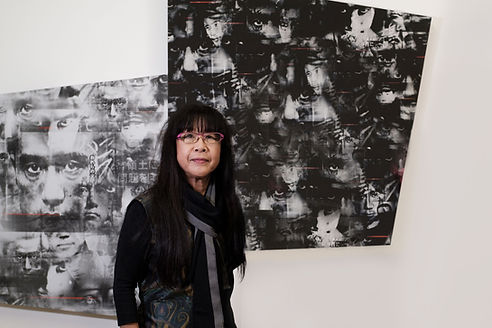
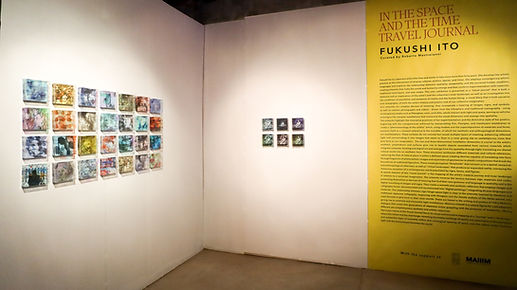
Fukushi Ito, a Japanese artist who has lived and worked in Italy for more than forty years, develops his research at the intersection of cultures, poetics, spaces, and different temporalities. He employs the languages of contemporary art and investigates the relationship between spatiality, temporality, and the universal existential condition, creating works capable of revealing both the world and the human condition, while combining experimentation with materials, traditional techniques, and new media. This solo exhibition is presented as a “travel journal” that is at once memory and exploration of the artist’s inner landscape and that of the collective imagination, as well as an inquiry into the conditions of possibility and existence of reality and the human being: a visual diary that becomes both narrative and cartography, tracing the history and poetics of the artist as well as our shared imaginary.
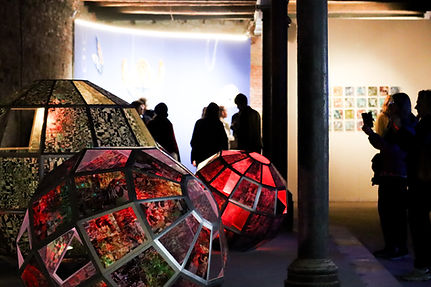
Ito’s works are complex devices of meaning: they integrate layered images, signs, and symbols, realistic photographs and videos drawn from the infosphere and traditional iconography, using contemporary media such as plexiglass, neon, and LED lights, all interacting with light and space as vectors for creating complex installations that transcend the visual dimension and emerge within spatial experience.
The works highlight the innovative practices of his experimentation and the distinctive character of his poetics, beginning with transparency effects achieved through the manipulation of film, plexiglass, and translucent membranes, in order to create a “phenomenology of the visible” that, through shadows and overlapping materials and forms, constantly refers to the invisible, of which the aesthetic and anthropological dimensions become manifestations. These surfaces do not conceal but rather reveal multiple layers of meaning, enhancing reflected light and concentrating it into images that seem to float in emptiness, giving rise to contemporary icons that shape our collective imagination.
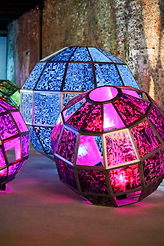
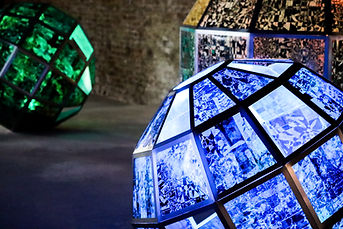
The bidimensional and tridimensional installation dimension is central to the artist’s poetics: polyhedrons and surfaces generate backlit objects assembled from different materials which, integrating computer drawing and digital art, emerge through light from spatiality itself, translating our shared cultural world into aesthetic form. These structures synthesize diverse materials and cultural references, capturing the flow of time and situating it within a delimited space, creating devices capable of translating fragments of photorealistic imagery and asymmetric geometries into plastic tableaux that break beyond the boundaries of traditional figuration. Thus emerge perceptual “thresholds” that connect us with spatial, temporal, and anthropological alterity, as well as “virtual landscapes” that produce an expanded reality, restoring the immersive sensation of a contemporaneity populated by signs, forms, and figures.
A central element of this “travel journal” is the cartography of the artist’s journey and inner landscape in relation to a universal imaginary. The works traverse the tension between sign, materials, and codes, presenting themselves as devices of meaning whose grammar and language are grounded in spatiality and the digital reworking of images and signs, generating a semiotic and aesthetic reflection that employs images and calligraphy, deconstructed and recomposed into “digital paintings,” integrating different languages and materials.
The relationship between sign, image, space, and light is evident in works inspired by traditional Japanese literature and calligraphy, beginning with Hiragana and the women writers of the Heian period, who used Onnade to give form to their interiority. These references are brought into dialogue with the writing and poetics of Yukio Mishima, generating essential and minimalist luminous installations. Mishima himself becomes a central figure in a paradigmatic dialogue uniting two generations of Japanese artists confronting the pressures of modernity, offering different yet complementary aesthetic and artistic responses.
The iconic character of this Travel Journal resides in its visual and allusive mapping of a “journey” and a “landscape” in which the virtual and the real merge, revealing the hidden mechanisms of reality and restoring both the perceptual and existential logic of human experience within that ontological spatio-temporal openness where matter becomes light and the environment becomes world.
10.05 - 24.05.2026 | supported by Kodama Biulding and MAIIIM