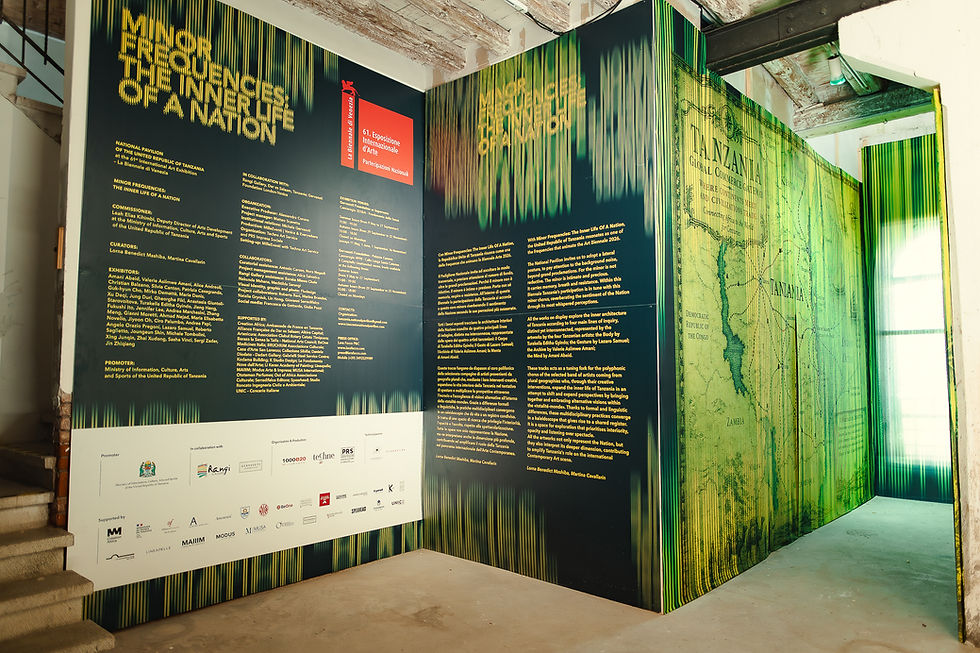
Tanzania National Pavilion
Gervasuti Foundation at Supernova - Exhibition venue Cannaregio 3218/A - Fondamenta della Sensa
Summer hours (from 9 May to 27 September): 11:00 - 19:00
Autumn hours (from 29 September to 22 November): 10:00 - 18:00
Closed on Mondays (except 11 May, 1 June, 7 September, 16 November)

THE PAVILION
Curated by
Lorna Benedict Mashiba,
Martina Cavallarin
Exhibitors:
Amani Abeid
Valerie Asiimwe Amani
Alice Andreoli
Christian Balzano
Silvia Canton
Patrizia Casagranda
Guk-hyun Cho
Mirko Demattè
Marie Denis
Xu Deqi
Jung Duri
Gheorghe Fikl
Anastasia Giuntoli-Starovoitova
Turakella Editha Gyindo
Jiang Heng
Fukushi Ito
Jennifer Lee
Andrea Marchesini
Zhang Meng
Gianni Moretti
Ahmad Nejad
Maria Elisabetta Novello
Jiyoon Oh
Ciro Palumbo
Andrea Papi
Angelo Orazio Pregoni
Lazaro Samuel
Roberto Saglietto
Joungeun Shin
Michele Tombolini
Xing Junqin
Zhai Xudong
Sasha Vinci
Sergi Zader
Jin Zhiqiang
With Minor Frequencies: The Inner Life Of A Nation, the United Republic of Tanzania resonates as one of the frequencies that animate the Art Biennale 2026.
The National Pavilion invites us to adopt a lateral posture, to pay attention to the background noise, beyond grand proclamations. For the minor is not reductive. The minor is intimate and precious. It carries memory, breath and resistance. Within this Biennale Tanzania’s participation is in tune with this minor chorus, reverberating the sentiment of the Nation through its most whispered perceptions.
All the works on display explore the inner architecture of Tanzania according to four main lines of inquiry, distinct yet interconnected, represented by the artworks by the four Tanzanian artists: the Body by Turakella Editha Gyindo; the Gesture by Lazaro Samuel; the Archive by Valerie Asiimwe Amani; the Mind by Amani Abeid.
These tracks acts as a tuning fork for the polyphonic chorus of the selected band of artists coming from plural geographies who, through their creative interventions, expand the inner life of Tanzania in an attempt to shift and expand perspectives by bringing together and embracing alternative visions within the «totalité-monde». Thanks to formal and linguistic differences, these multidisciplinary practices converge in a kaleidoscope that gives rise to a shared register. It is a space for exploration that prioritises interiority, opacity and listening over spectacle. All the artworks not only represent the Nation, but they also interpret its deeper dimension, contributing to amplify Tanzania’s role on the international Contemporary Art scene.
Art cannot be reduced to a symbolic commentary on current events or factual reality. Rather, it activates norms and frameworks that constitute a grammar conceived under the banner of a transformative and ever-changing alchemy, governed by the artist’s perspective. It does so by moving through the fertile humus of opacity, leading us towards the marginal and the invisible, where spirituality and metaphysics, symbol and archetype, reclaim – through signs and traces – worlds and fragments of existence.
Therefore, Minor Frequencies: The Inner Life Of A Nation represents an attempt to venture beyond familiar territories, with the courage to explore and allow ourselves to be unsettled by that magnificent, powerful and independent device that is the artwork. The exhibition project offers a convergence of viewpoints, exploring the contemporary tension offered by creations of various nature and style, among realism, dream, chromatic nuances and transparency, for an exhibition that aims to leave a distinct and tangible mark on a possible and fertile dialogue. It is a matter of giving free rein to a process of engagement triggered by the presence of the artwork, with the aim of redefining the common perception of our place in the world, re-establishing its balances, both within and beyond the exhibition space.
The exhibition unfolds like a sphere of relational topographies where curiosity can be nurtured, where we can lose ourselves, amplify questions and open ourselves up to the cultural, artistic, social and anthropological desire to better understand which minor frequencies – even those merely dreamt of by art – emerge from our Nation. The National Pavilion of the United Republic of Tanzania becomes more than just an exhibition: an atmosphere, a space that, in turn, listens.